Before you sign with a cannabis distributor in New York, ask four questions about its network, ordering platform, inventory process, and how it collects your money.
In New York, a licensed distributor stores a cannabis brand's product, delivers it to dispensaries, and collects payment from retailers, who must pay within 30 days of delivery when they buy on credit. The distributor's warehouse, delivery network, and collections process can decide how fast a brand grows and gets paid.
This guide, drawn from the Nabis masterclass on cannabis distribution and payments for the Gotham Growth Project, walks founders through important questions to ask any distributor. It is written for founders who already have products on shelves or are close to it.
Why the Gotham Growth Project Came to the Bronx
Nabis recently hosted the Gotham Growth Project at its Bronx, New York facility. The Gotham Growth Project (GGP) is a six-session accelerator for growth-stage cannabis consumer-product founders in New York City.
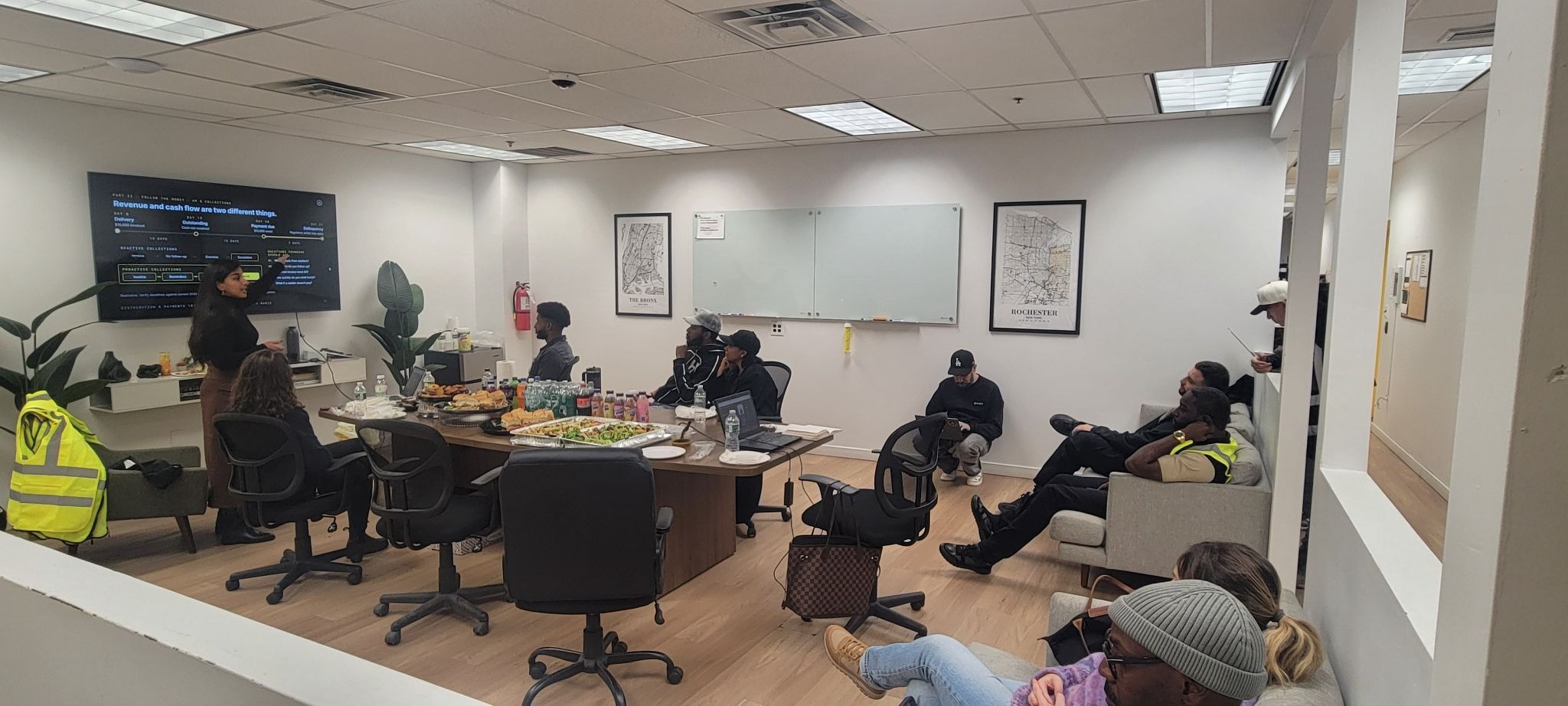
Its inaugural group dedicated to supporting Black-owned cannabis businesses, includes four New York brands: High Priestess, which went from four retailers to six during the program; Söze, which is targeting $2 million in New York revenue in 2026; Terracotta; and Hi Intentions. GGP is an education program and does not provide direct funding. Its founders already sell through licensed retailers.
We built a two-hour masterclass around the two foundational things they need to know: who moves their product to market, and who makes sure they get paid.
Follow the Product
Nabis is the largest licensed cannabis distributor in the US, operating in California, New York, and Nevada, with one platform for distribution, a wholesale marketplace, payments, and capital.
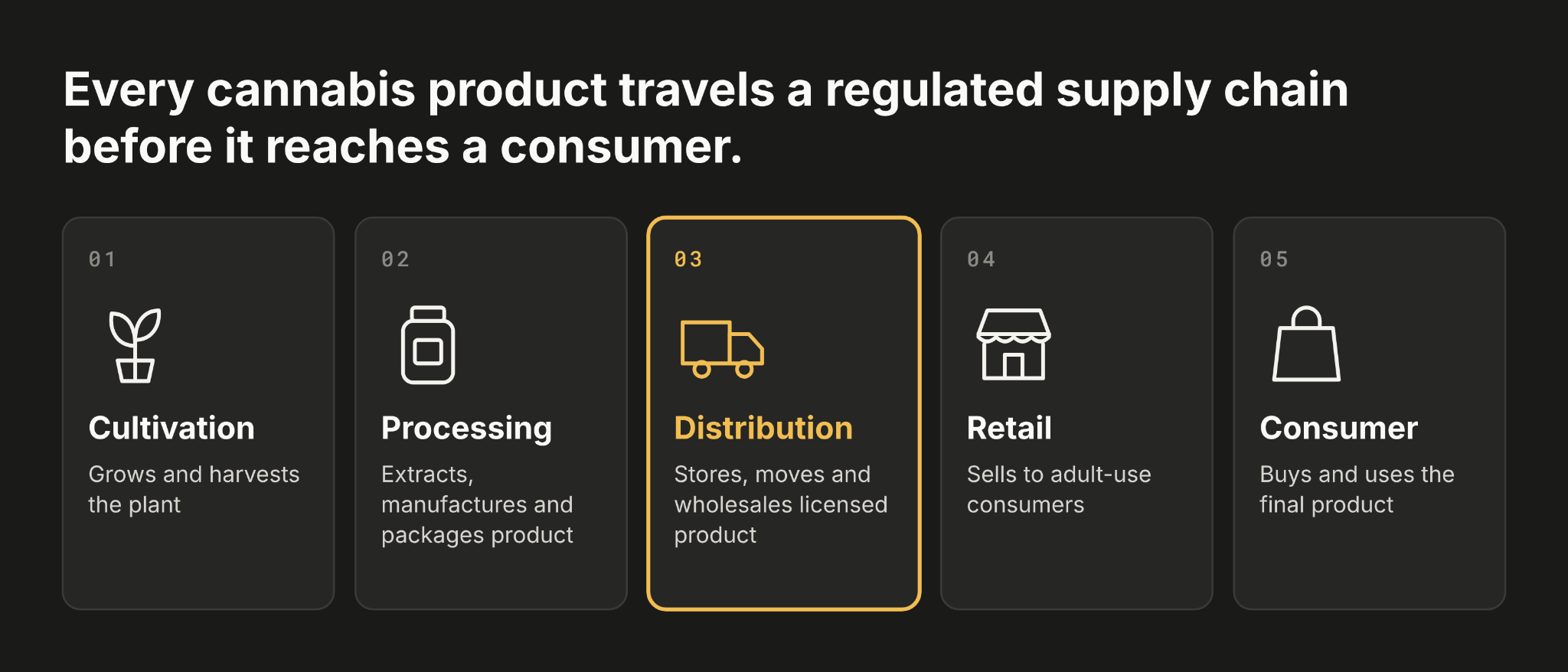
Every cannabis product travels the regulated supply chain before it reaches a consumer, and in each state, the regulations are different. In New York, the supply chain is structured as follows:
- Cultivation: growers plant and harvest the crop.
- Processing: extractors and manufacturers turn it into packaged products.
- Distribution: licensed distributors store, move, and wholesale that product.
- Retail: more than 700 dispensaries sell to adult-use customers.
- Consumer: purchase the product for consumption. And, according to a New York State Department of Health Behavioral Risk Factor Surveillance System (BRFSS) report, roughly 2 million adults consumed cannabis in the past 30 days.
- Microbusiness: a small, vertically integrated New York licensee that must grow cannabis and can also process, distribute, and sell its own products at retail, but does not distribute other brands’ products.
What can a distributor do?
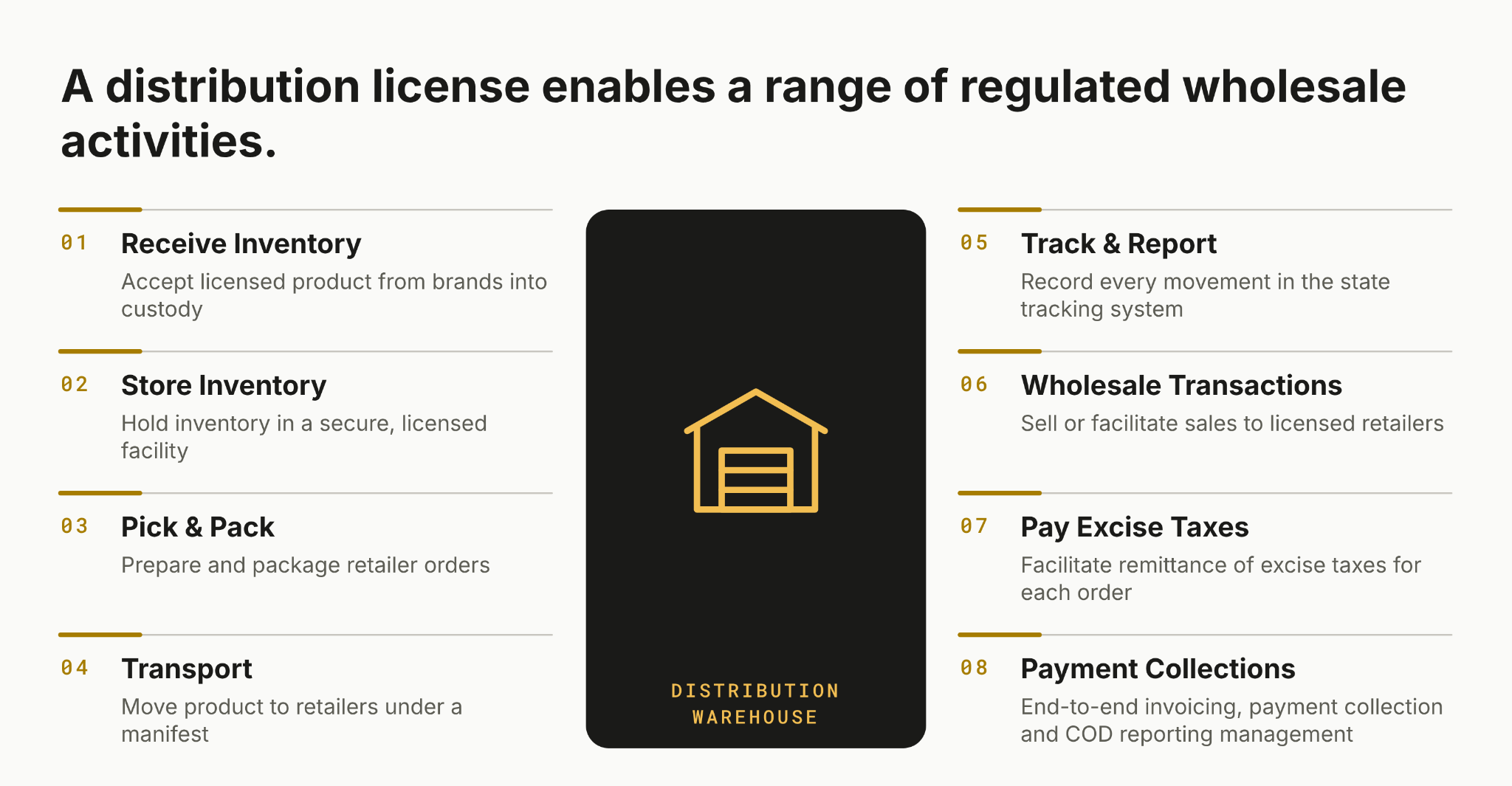
A licensed cannabis distributor can receive inventory from manufacturers, store product, prepare and package orders, transport those orders under a manifest tracked in Metrc, facilitate remittance of excise taxes for each order, and, importantly, collect payments from retailers for brands.
With the right partner, it can be a growth engine that gets brands into new retail shops and ensures you are paid on time.
- Receive inventory: accept licensed products from brands into custody.
- Store inventory: hold it in a secure, licensed facility.
- Pick and pack: prepare and package retailer orders.
- Transport: move product to over 700 New York retailers under a manifest, the record of exactly what is on the truck.
- Track and report: record every movement in the state tracking system, Metrc.
- Wholesale transactions: sell or facilitate sales to licensed retailers.
- Pay excise taxes: facilitate remittance of excise taxes for each order.
- Payment collections: handle end-to-end invoicing, payment collection, and COD reporting.
Given how much of a growth engine a distribution partner can be, it's critical to understand how your distribution partner operates.
How to evaluate a distributor's warehouse
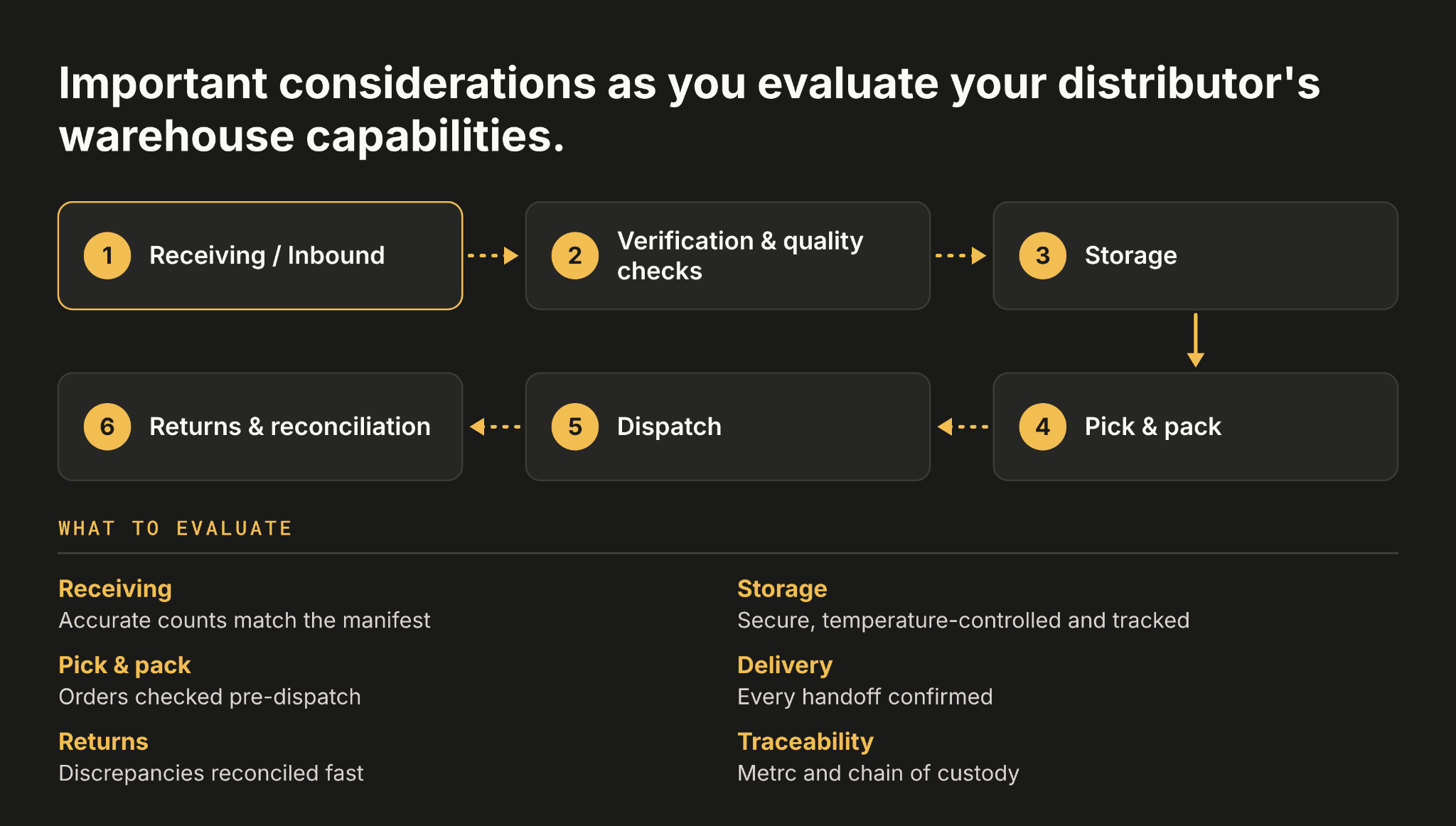
Product passes through six zones inside a distribution warehouse: receiving, verification and quality checks, storage, pick and pack, dispatch, and returns and reconciliation. Founders should check each one:
- Receiving: counts match the manifest.
- Storage: secure, temperature-controlled, and tracked.
- Pick and pack: orders are checked before dispatch.
- Delivery: every handoff is confirmed.
- Returns: discrepancies get reconciled fast.
- Traceability: Metrc records and chain of custody hold up.
A box arriving at a dispensary is only one part of a completed delivery. The Gotham Growth Project group saw each zone in action on the Bronx warehouse tour.
Who collects from your retailers, and what happens when one doesn't pay?
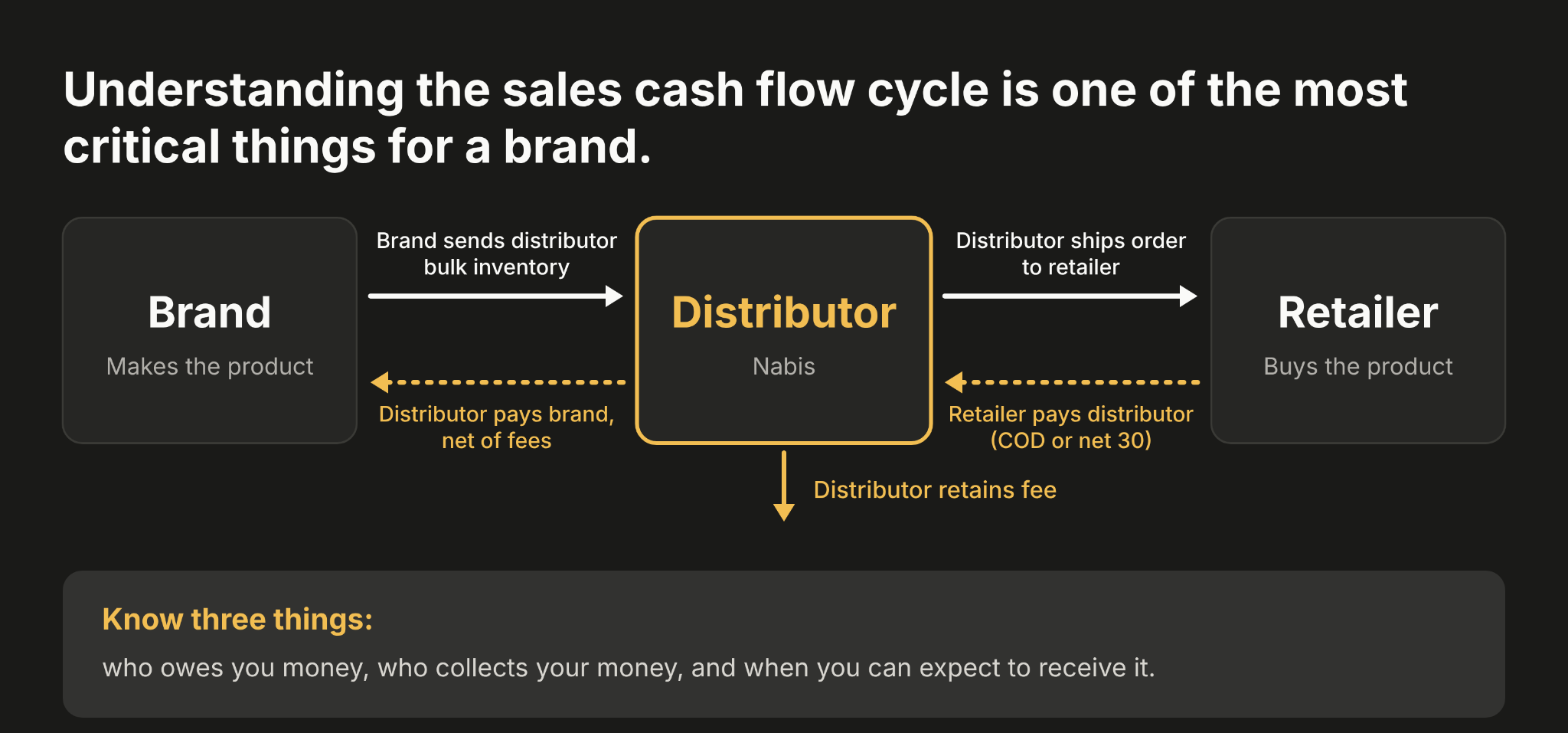
Understanding collections and cash flow cycles is a critical requirement for brands. Some distributors, such as Nabis, manage collections for the brands they distribute.
In New York, retailers are allowed a maximum payment term of 30 days. By day 37, if a retailer hasn’t paid, the supplier may report the payment as delinquent in Metrc, the state’s track-and-trace software, and the retailer is added to the Office of Cannabis Management's (OCM) COD list, which now lives in Metrc. OCM's delinquent payments guidance sets the 30-day rule, counts calendar days, and lets the Cannabis Control Board approve different terms.
When a distributor manages both shipping and payments, product and money travel in opposite directions. The brand sends inventory to the distributor; the distributor ships wholesale orders to the retailer; the retailer pays the distributor; and the distributor pays the brand, net of its fees. The distributor also pays the 9% excise tax, which is incurred at the point of delivery. 3
A brand books revenue at delivery but gets cash only when the retailer pays, and that gap is known as its accounts receivable (AR). On a $10,000 credit delivery, the brand holds an invoice and no cash until the retailer actually pays (ideally by day 30).
Different distributors may have different collections strategies, and knowing this is important for brands. Some distributors chase late payers only after an invoice goes overdue. Others send reminders, reconcile as payments arrive, and remit on a schedule. To understand how efficient a distributor’s collections process is, brands should always ask:
- Which party is responsible for collecting payments from retailers?
- How often do you follow up?
- Can I see invoice-level AR?
- How quickly do you remit funds?
- What happens if a retailer doesn't pay?
Which retailers can your distributor reach, and how often?
New York gives you three ways to get licensed product to retailers:
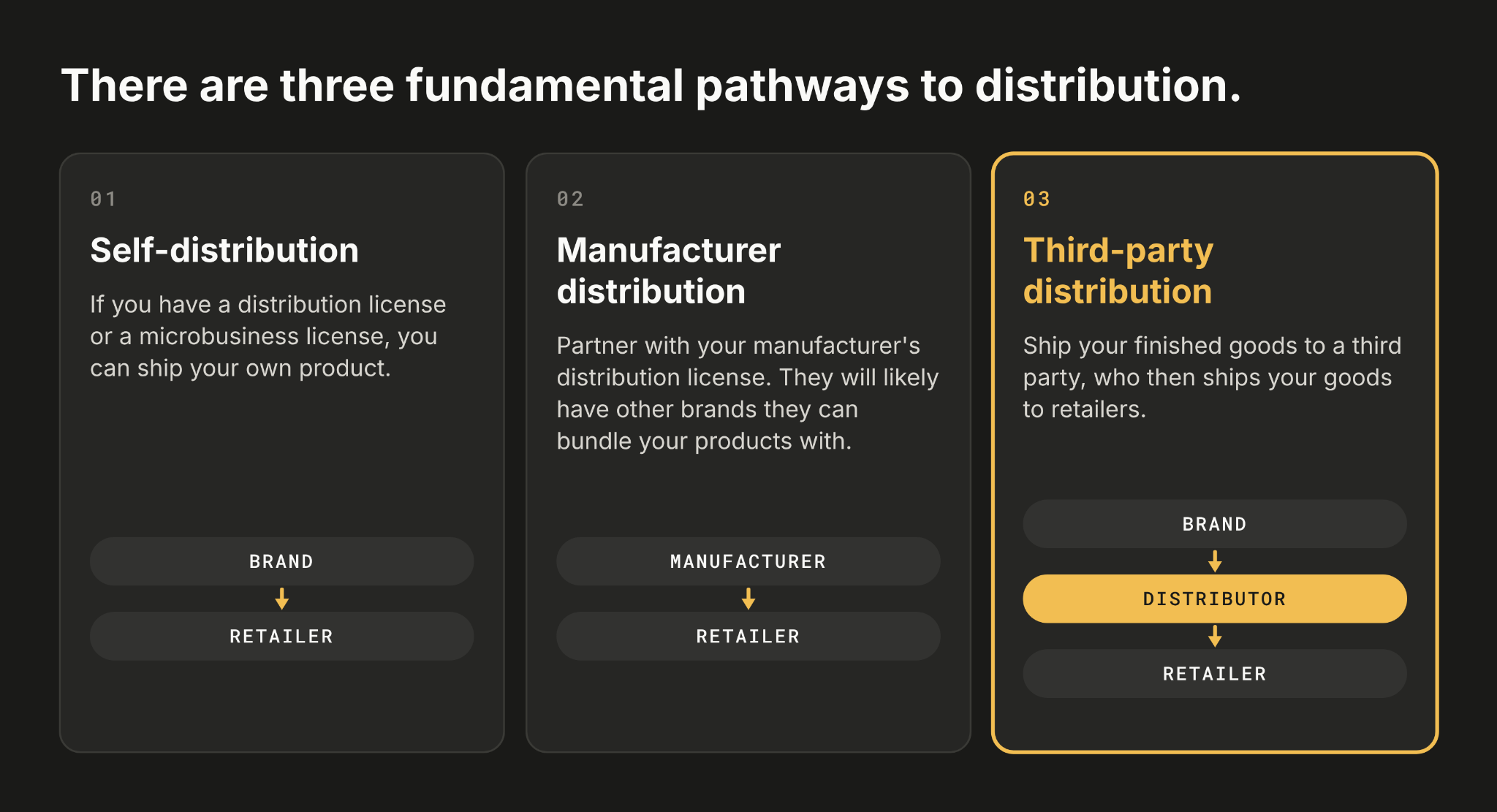
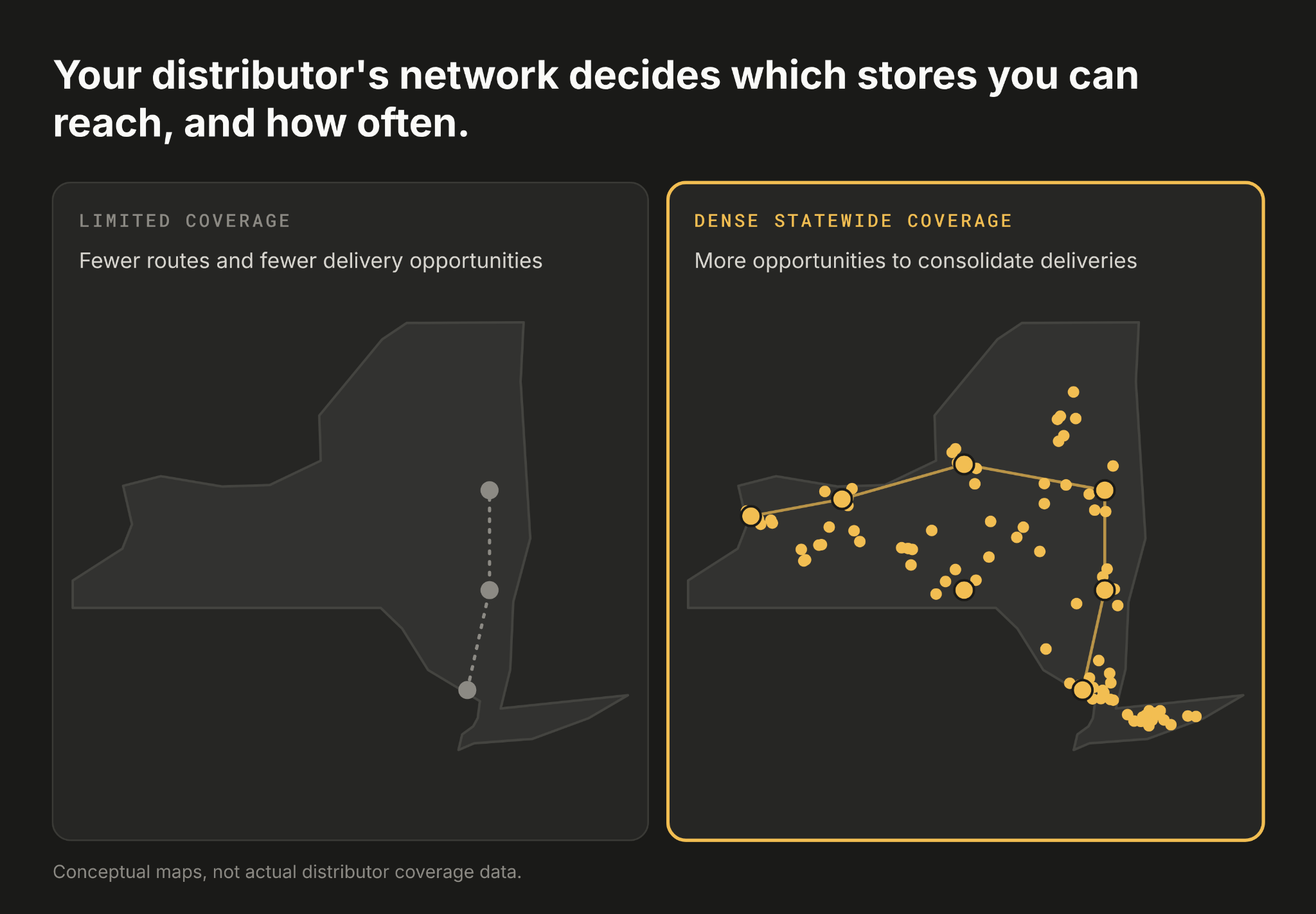
With a third-party distributor, four factors separate one partner from another: network, order economics, inventory control, and technology. Limited coverage means fewer routes and fewer delivery opportunities, while dense coverage lets a distributor consolidate deliveries. Ask which retailers it serves, how often it delivers to them, what areas it covers, and how it helps brands expand their footprint. Ask:
- Which retailers do you serve?
- How frequently do you deliver to them?
- What geographic areas do you cover?
- How do you help brands expand their footprint?
Will your distributor do smaller orders every week?
Given New York’s strict 30-day payment requirements, retailers increasingly want smaller orders so they can pay on time and avoid being placed on the Metrc COD list. However, while one $4,000 monthly order and four $1,000 weekly orders add up to the same monthly revenue, each puts very different demands on a distributor.
Distributors carrying a large number of brands in their portfolio can bundle orders to offset fixed shipping costs, while smaller distributors struggle to keep costs manageable because they must make smaller deliveries more frequently.
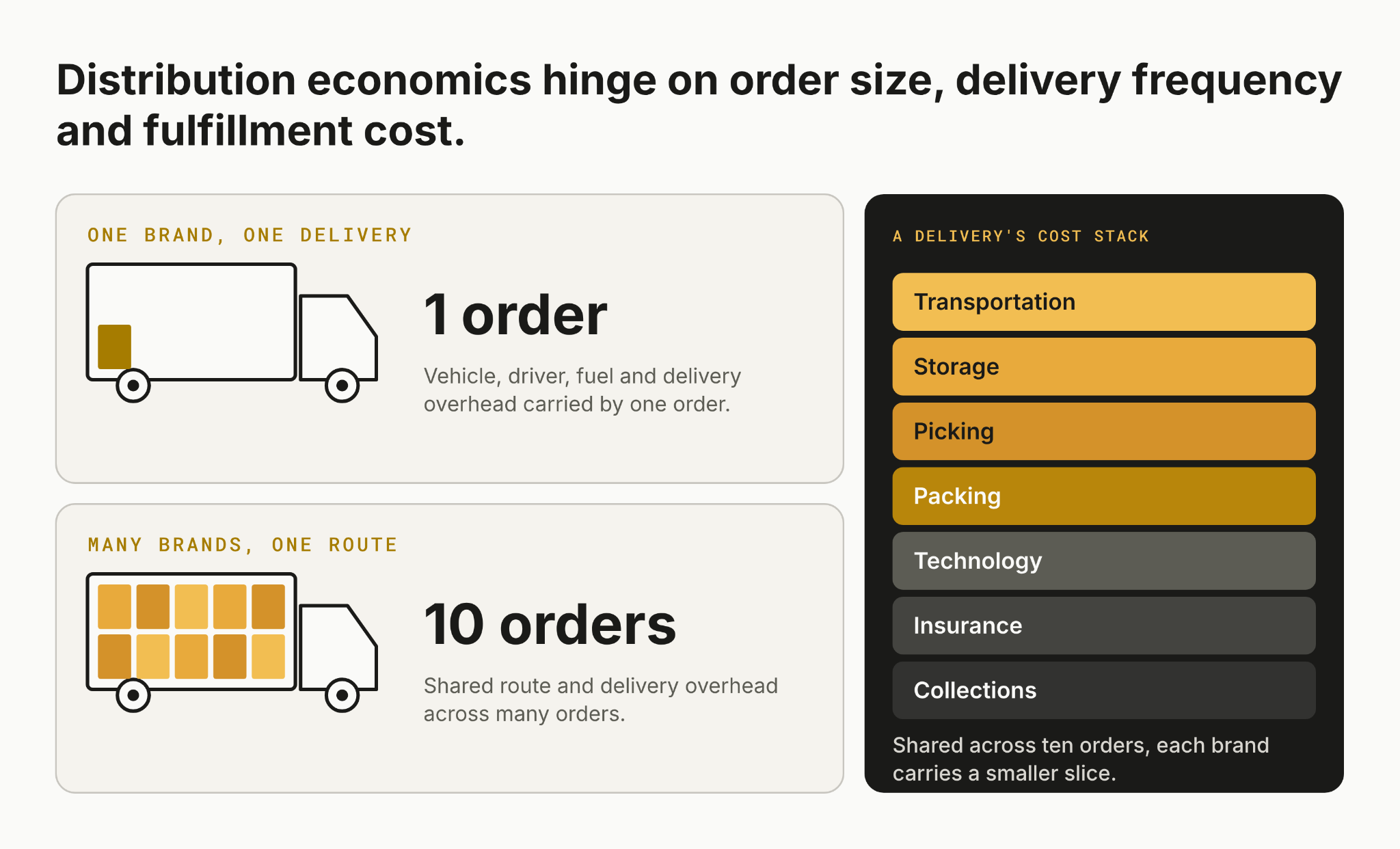
Each delivery carries distinct costs, including transportation, storage, picking, packing, technology, insurance, and collections. Whether a truck has one order or ten, it will incur the same costs for the vehicle, driver, fuel, and overhead. As such, working with a distributor can decrease costs for operators by leveraging shared infrastructure across many brands.
Minimum shipping fees are another metric that brands should always ask their distributors about. Ask what minimums the distributor sets, what fees apply to small orders, how often it can deliver, and whether multiple brands can share one delivery.
Can you see your inventory in real time?
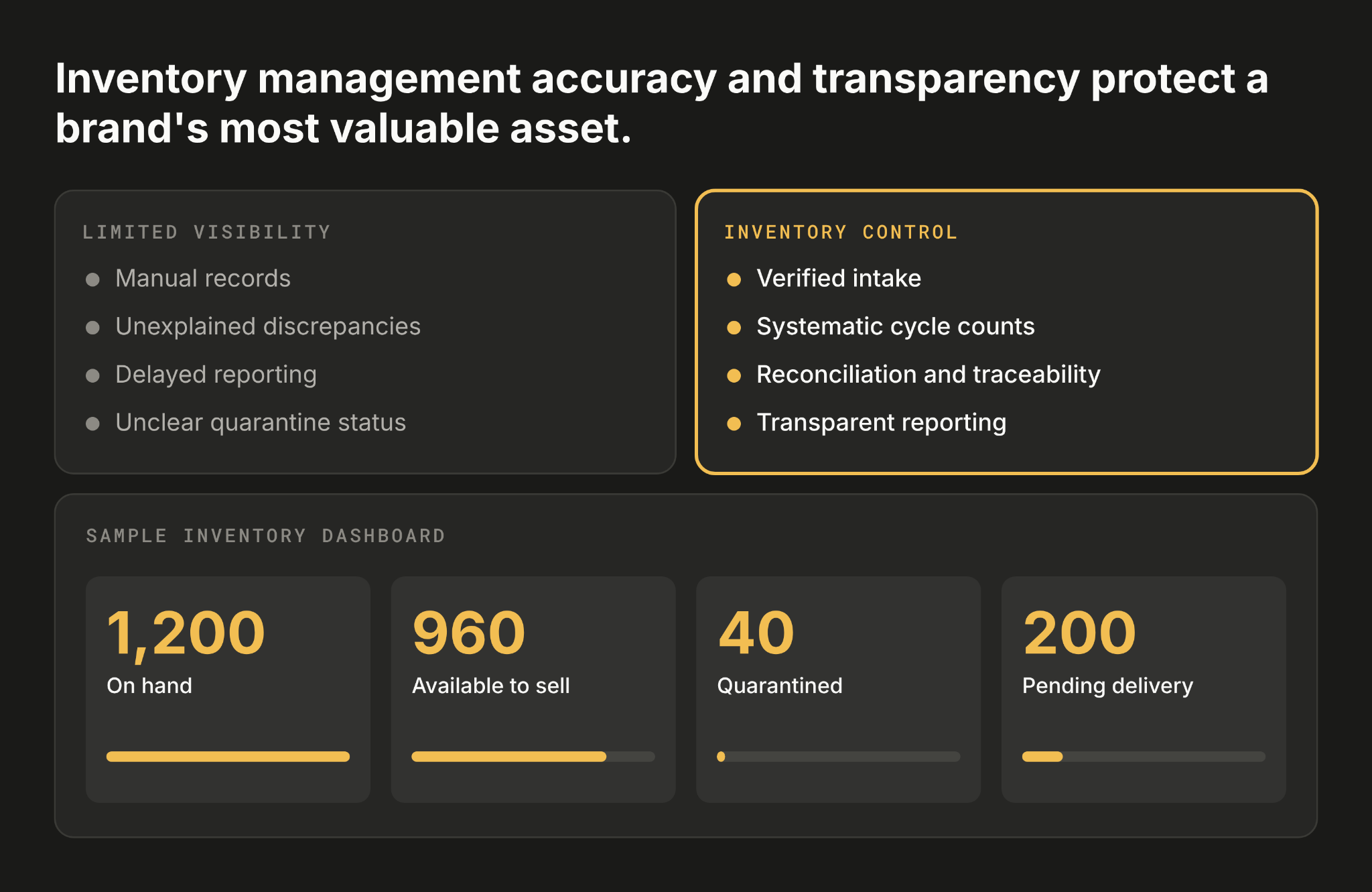
Brands must understand how much inventory they have in order to properly run their sales efforts. A distributor that counts inventory on a schedule, shows it in real time, and clarifies who pays for lost or damaged goods is the best partner because it lets brands plan their sales and cash cycles efficiently.
Product passes through six warehouse zones: receiving, verification and quality checks, storage, pick and pack, dispatch, and returns and reconciliation. Receiving counts should match the manifest, storage should stay secure and temperature-controlled, and Metrc records and chain of custody should hold up. The Gotham Growth Project group saw each zone on the Bronx warehouse tour.
A distributor with limited visibility works from manual records, reports late, and leaves quarantine status unclear. One with inventory control verifies intake, runs cycle counts (regular partial recounts of stock), and reports transparently. Ask:
- How often is inventory counted?
- Can I see inventory in real time?
- How are discrepancies resolved?
- Who is financially responsible for lost or damaged goods?
What's Next
Put these four questions to every distributor you meet, Nabis included. Compare the answers side by side. Save this guide or send it to a co-founder, and talk to the Nabis team when you are ready. Nabis is currently developing a new small business program to help more businesses like those in the Gotham Growth Partners cohort get the tools they need to grow.
Frequently Asked Questions About Cannabis Distribution in New York
What does a cannabis distributor do in New York?
A licensed cannabis distributor in New York receives, stores, picks, packs, and transports licensed products to retailers under a manifest. It also records every movement in the state tracking system, facilitates excise tax remittance, and manages invoicing and payment collection.
What are the ways to get a cannabis product to New York dispensaries?
A New York brand can self-distribute with a distribution or microbusiness license, partner with its manufacturer's distribution license, or ship finished goods to a third-party distributor such as Nabis.
How does a cannabis distributor get paid?
A cannabis distributor collects payment from the retailer, either cash on delivery or on net 30 terms, keeps its fee, and pays the brand the remainder.
What does net 30 mean in cannabis wholesale?
Net 30 means a retailer buying on credit has 30 days from delivery to pay the supplier's invoice, and New York's OCM requires payment in that window unless the Cannabis Control Board approves otherwise. On day 37, a retailer that is still unpaid lands on the state's COD list.
Why do shared delivery routes lower a brand's distribution cost?
Every order on the route shares a delivery's costs (transportation, storage, picking, packing, technology, insurance, and collections). With ten orders on one truck, each brand carries a smaller slice than it would shipping alone.
What should a brand ask a distributor about inventory?
A brand should ask its distributor how often inventory is counted, whether you can see it in real time, how discrepancies are resolved, and who is financially responsible for lost or damaged goods.
Where are Nabis's New York facilities?
Nabis operates two New York hubs, one in the Bronx and one in Rochester.
What is the Gotham Growth Project?
The Gotham Growth Project is a six-session accelerator for growth-stage cannabis consumer-product founders in New York City. Its inaugural cohort, the Black Ownership Cohort, supports Black-owned brands.